 [Click
for more detailed image]
[Click
for more detailed image]
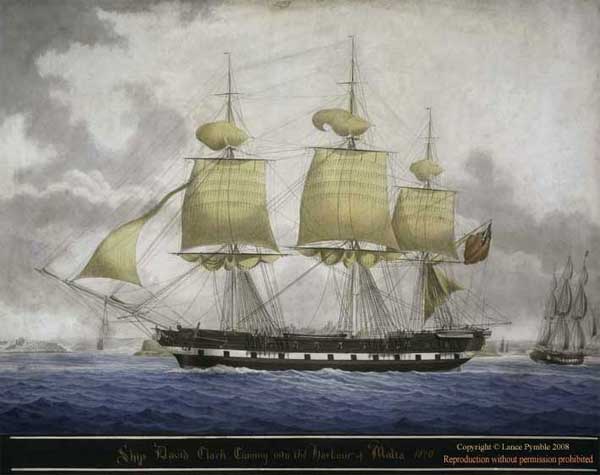
The Painting
Watercolour and ink on paper,
45cm x 60cm. Entitled "Ship David Clark Caming [sic] into
the Harbour of Malta 1820"
The painting depicts the three
masted ship David Clark taking in sail in preparation for
entering Grand Harbour, Malta under topsails. The fore course,
main course and spanker are clewed up. The topgallant yards are
lowered and the topgallants are being clewed up. The jib is being
hauled down. The flying jib, foremast staysail and the three royals
are furled above their yards. The British Red Ensign flies from
the ensign halliard on the spanker gaff. The figurehead is a gentleman
pointing. The martingale appears to be doubled. Seven guns are
visible, on the port side. The ship has two boats visible on davits
aft and and a long boat on the deck midships. The ship astern
is, in all probability, a view of the same vessel from the starboard
quarter although that ship does not appear to carry royals and
carries no boat at the stern.
The rendition of the sails resembles
that in Nicolas Cammillieri's signed watercolour of HMS Prososalpina
dated 1817, in the collection of the Martime Museum of Malta.[1]
The title block and lettering
style match several works attributed to Nicolas Cammillieri, in
particular one entitled "Sovereign, John Wells Commander
coming into Malta 1826" in the Peabody Museum, Boston [M8959].[2]
A Brief History of
the 'David Clark'
The
David Clark was built in 1816 by S. Teague at the Clive
Street yards on the Hoogley River, Calcutta[3] for Messrs
Ferguson and Company and named after a partner in that firm.[4]
She was 608 & 29/94 tons, 123 feet 9 inches between perpendiculars,
with beam of 33 feet 3 inches. [5]
In early 1820 she was
in Malta having arrived from Bengal. Presumably this was when
her portrait was painted. By the 27th September, 1821 she was
back in Bengal having sailed from Gibraltar.[6]
In 1824 and 1825 the David
Clark was involved in the East India Company's military
expedition against Burma involving 20,000 troops. She was used
as a hospital ship in the Arracan campaign. [7]
Lloyd's Register records her as being
in the service of the East India Company and trading between London
and Madras & Bengal in 1830.[8]
In 1834 the East India
Company ceased commercial activities in the east. In one of
the final voyages under licence by the East India Company, the
David Clark sailed from Calcutta to Singapore, China, St
Helena and London from 19th August, 1833 to 28th June, 1834 with
Robert Rayne as master. The log of this voyage has survived.[9]
Following the voyage under
licence to the East India Company the vessel was surveyed in London
on 16th August,1834. The survey indicates the the vessel was built
in teak and had two decks. She was sheathed in wood in 1829 and
in coppered in Calcutta in 1833. At the time of the survey she
had new lower rigging and a new rudder. She is listed as carrying
a long boat, a pinnace and a joley boat. Unfortunately the survey
does not give the dimensions of the ship. She was classified Æ,
which indicated her suitability for conveying dry cargoes worldwide.[10]
From 1834 to 1839 she
worked the London-Calcutta and Calcutta-China route until January
1839 when she left London for India but put in at Cowes, leaking
and had to discharge her cargo before heading to Greenock for
a substantial refit.[11]
In 1839 the David Clark
was chartered to bring the first bounty immigrants from Scotland
to Melbourne. She left Greenock on 13th June 1839 to the tune
of Lochaber No More piped by John Arthur and arrived Rio
de Janeiro 15th August, 1839, stayed approximately ten days, then
sailed direct for Port Phillip arriving 27th October, 1839. She
departed Port Phillip for Bombay on 19th December, 1839.[12][13]
In 1841 she was back in
Australian waters, transporting convicts and troops from Plymouth
to Hobart, having departed on 7th June 1841, arriving 4th October,
1841. She departed Hobart on 17th October, 1841 for Bombay with
ballast. [14]
I am yet to consult
Lloyd's List for the period 1843 to 1848 but the indexes indicate
several mentions of the ship.
On 7th September, 1853
the David Clark set sail from Manilla bound for London
but encountered heavy storms and put back to Manilla, leaking,
on the 12th September. Her cargo was undamaged and after re-caulking
she sailed again for London, via, Melbourne, on 23rd September,
1853. On route through the Sunda Strait she hit a reef and was
forced to out into Anjer, Java, on 31st October, 1853. From Anjer
she made her way, leaking, to Batavia, arriving on 18th November,
1853 where she was condemned. Lloyd's List gives her master's
name at this time as variously "Bond" or "Boyd"
but I suspect "Bond" is merely a transcription error
for "Boyd".[15]
Under a new master, Deighton,
the David Clark left Batavia for Sourabaya on 20th February,
1854 but put into Samarang on 24th February, eventually arriving
in Sourabaya on 6th March, 1854.[16]
The David Clark does
not appear in Lloyd's List after August,1854. After setting
out from Batavia on the 5th June, 1854 bound for Singapore, she
is recorded as arriving Sourabaya, 5th June, 1854 and returning
to Batavia on 17th June, 1854. Her last recorded master was Deyton
or Deighton. Presumably she was broken up in Batavia in 1854.[17]
Voyages
|
Date of Departure |
Port of Departure |
Port of Call |
Port of Arrival |
Date of Arrival |
Master |
Source |
|
1820 |
Valletta |
Gibraltar |
Calcutta |
1821 Sep 27 |
Miller |
Lloyd's List |
|
1824, Aug 21 |
Madras |
|
Rangoon |
|
Falconer |
Asiatic Journal Feb1825 |
|
1825, Apr 4 |
Bombay |
|
Rangoon |
|
Falconer |
Asiatic Journal Nov1825 |
|
1827, Jul 17 |
Calcutta |
|
Isle of France |
|
Viles |
Asiatic Journal Feb1828 |
|
1828 |
Isle of France |
Madras & Eskapilly |
Calcutta |
1828, Jan 28 |
Viles |
Asiatic Journal May & July 1828 |
|
1829 Jun 16 |
Calcutta |
|
London |
1829 Nov 4 |
Viles |
Asiatic Journal Dec 1829 |
|
1830 Sep 2 |
Calcutta |
|
Singapore |
1830 Sep 26 |
J.B.Viles |
Singapore Chronicle Oct 7, 1830 |
|
1833 Sep 21 |
Calcutta |
Singapore |
Whampoa (Canton) |
1833 Dec 24 |
Robert Rayne |
Log of the Ship David Clark 1833-1834 |
|
1834 Feb 5 |
Whampoa (Canton) |
St Helena |
London |
1834 Jun 28 |
Robert Rayne |
Log of the Ship David Clark 1833-1834 |
|
1837 Nov 14 |
Bombay |
Singapore |
Canton |
1838 Feb 5 |
Hutchinson |
Lloyd's List |
|
1838 Mar 25 |
Canton |
St Helena |
London |
1838 Sep 24 |
Hutchinson |
Lloyd's List |
|
1839 Jan 16 |
London |
Sailed for India but returned to Cowes leaking then sailed for
Greenock |
Greenock |
|
Callender |
Lloyd's List |
|
1839 Jun 13 |
Greenock |
Rio de Janeiro |
Port Phillip |
1839 Oct 27 |
Mills |
Shipping Arrivals and Departures Victorian Ports Vol 1 |
|
1839 Dec 19 |
Port Phillip |
|
Bombay |
1840 Mar 3 |
Bruce |
Shipping Arrivals and Departures Victorian Ports Vol 1 |
|
1840 Mar 21 |
Bombay |
|
Aden |
|
Mills |
Lloyd's List |
|
1840 |
Aden |
|
Bombay |
1840 May 15 |
Mills |
Lloyd's List |
|
1840 Jun 26 |
Bombay |
|
Calcutta |
1840 Jul 6 |
Mills |
Lloyd's List |
|
1840 |
Calcutta |
Cape Town |
London |
1841 Mar 19 |
Mills |
Lloyd's List |
|
1841 Jun 7 |
Plymouth |
|
Hobart |
1841 0ct 4 |
Mills |
Shipping Arrivals and Departures Tasmania |
|
1841 Oct 17 |
Hobart |
|
Bombay |
|
Wm.B. Mills |
Shipping Arrivals and Departures Tasmania |
|
1843-1848 |
Yet to be detailed |
|
|
|
|
|
|
1852 |
Clyde |
|
Bombay |
1853 Jan 12 |
Boyd |
Lloyd's List |
|
1853 Feb 27 |
Bombay |
|
Whampoa |
1853 May 25 |
Boyd |
Lloyd's List |
|
1853 Jul 11 |
Canton |
|
Manilla |
1853 Jul 26 |
Boyd |
Lloyd's List |
|
1853 Sep 22 |
Manilla |
|
London |
|
Bond |
Lloyd's List |
References
1. Melita
Historica. 11(1993)2(143-156) [Link]
2. Brewington,
M.V. & Brewington, Dorothy, The Marine Paintings and Drawings
in the Peabody Museum, Salem, Massachusetts, 1968. pp26 &
48.
3. Phipps,
John, A Collection of Papers, Relative to Ship Building in
India, Scott and Co, Calcutta, 1840. p107. British Library,
T35395.
4. State
Records NSW: Colonial Secretary Papers, 1788-1825, [4/1785] p20,
1823, Apr 25. [Reel 6063].
5. Hackman,
Rowan, Ships of the East India Company, World Ship Society,
Gravesend, Kent, 2001. p267. I have been unable to locate Hackman's
primary sources for the tonnage and builder's measurements. The
rules for determining the tonnage and burthen of ships in Britain
were governed by acts of Parliament that required the keel length,
breadth and half the breadth be multiplied together and divided
by ninety-four [Link].
The length of the keel is normally determined by subtracting three-fifths
of the breadth from the length between perpendiculars, and the
width is taken at the broadest point, less the thickness of any
doubling planks.
6.
Lloyd's List, London, 1820-1854. Nos 5426 &
5575.
7. Asiatic
Journal and Montly Register for British India and its Dependencies,
London, 1824, Vol XVIII, July to December, 1824, pp332-333
8. Lloyd's
Register of British and Foreign Shipping 1833, London, 1833.
Underwriters, Ships in the East India Company's Service, Season
1830.
9.
National Archives UK: India Office Records. IOR/L/MAR/B/153A.
Log of the Ship David Clark on a Voyage from Calcutta to Singapore,
China and London. 19 August, 1833 to 28 June, 1834.
10.
National Maritime Museum UK. Survey 764, London, 16th August 1834.
11.
Lloyd's List, London, 1820-1854. Nos 7757, 7762
& 7764.
12.
Greenock Advertiser, 14th June 1839. "Yesterday, the ship
David Clark left this for Port Philip, New South Wales, with upwards
of 220 passengers who intend to settle in that colony. They are
cheifly agriculturalists, and from their appearance and behaviour
are evidently much superior to the ordinary class of emigrants.
This vessel was chartered by Government, and was inspected by
the Agent General of Emigration, from the Colonial Office, London,
who was highly pleased with her fitting up, and all the arrangements
connected with her." Several advertisements, calling for
various classes of workers and tradesman as well as married couples
under the age of fifty to apply to emigrate to New South Wales,
had appeared in the Greenock Advertiser during the earlier
months of 1839.
13.
Syme, Marten A., Shipping Arrivals and Departures, Victorian
Ports, Volume 1, 1788-1845, Roebuck Book, 1984-2006. p.39.
14.
Hawkins Nicholson, Ian, Shipping Arrivals and Departures Tasmania
Volume II 1834-1842 (Parts I, II and III) and Gazetteer of Tasmanian
Shipping 1803-1842 (part IV), Roebuck, Woden, A.C.T. 1983,
p208.
15.
Lloyd's List, London, 1820-1854. Nos 12397, 12406,
12407 & 12446.
16.
Lloyd's List, London, 1820-1854. Nos 12499, 12508
& 12523.
17.
Lloyd's List, London, 1820-1854. Nos 12589, 12601
& 12602.
Links
Andrea Cordani has been most helpful and encouraging and runs
comprehensive website on East
India Company Ships.
Access count:
Lance Pymble lance@pymble.id.au
Last updated 12th July 2024.
My
home page.